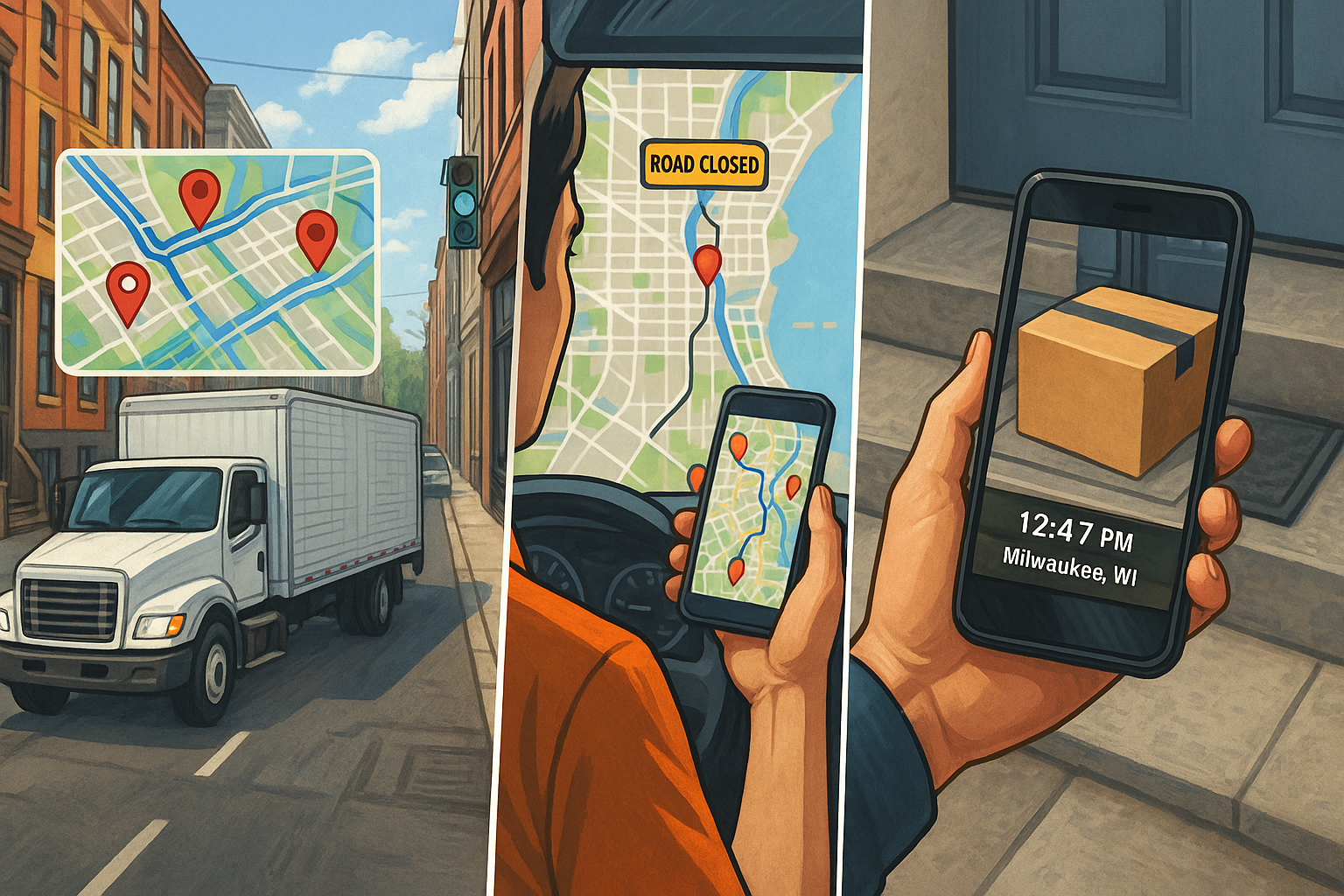
Launch of new delivery processes always deals with last-mile delivery issues — the inevitable last mile is the hardest leg in any logistics route. For dry vans carrying goods to Milwaukee’s urban destinations, it is particularly difficult to ensure seamless last-mile visibility. Narrow streets, unpredictable traffic, and various customer demands drive pre/post carriers to deliver last-mile visibility without failure. Nowadays, both big and small companies are leaning on a package of advanced technology — geolocation, mobile mapping, and driver apps with real-time text alerts — to shrink the distance between dispatches and police. In this article, we are going to discuss the unique challenges Milwaukee faces, the tools available for last-mile tracking, and the best practices to buoy your dry van operations.
Challenges Afflicting Milwaukee Urban Deliveries
- Tangled Street Network
The city’s plethora of one-way streets, neglected alleys, and few residential laden roads are enough to beat even expert drivers. The imprecise address verification makes this scenario worse by leading vans to incorrect routes or to dead ends. - Diverse Traffic Trends
After congestion during rush hours on I-43, the city experience can be worsened by activity-based traffic, especially to the Deer District area. Traffic avoidance is an important thing to keep in mind. Router strategies can be inefficient thanks to construction or accidents that materialize without warning. - Curbside Delivery Restrictions
Very few parking slots available, loading zone restrictions, and residential “no-parking” signs make curbside delivery like a balancing act. One blocked window bay to your circuit could push into delays across the entire package. - Customers’ Expectation for Delivery Proof
Both clients and freight forwarders demand various components for solid proof-of-delivery — beyond just a customers barely expressed wish of having a signature, they also want time stamps on their pictures, digital signatures, and in some cases, temperature logs for the goods shipped. - Climatic and Seasonal Influences
Milwaukee’s winters with snow and ice cause traffic, while the summer fairs shift it in the lakefront area. The integration of real-time weather reports into navigation systems gives the fleets a chance to adjust.

Final-Mile Visibility Technology Essentials
Creating a solid last-mile visibility is all about by several tools:
Geolocation & Mobile Mapping
In the urban areas with a high density of buildings, GPS alone cannot be relied on. The next-gen mobile mapping platforms provide the fusion of GPS and high-resolution street scans, thus ensuring the accuracy of geolocation pins down to the house number.
Driver Apps with Real‑Time Text Alerts
Smart apps for drivers help simplify navigation. For example, when a parade shuts down part of downtown, the dispatcher can send real-time text alerts straight to the driver’s phone. All of these accumulating features will soon blow the roof off the old routines.
POD Capture & Proof‑of‑Delivery
Today, drivers don’t need to deal with the fog of paper forms and tablets any more. The use of portable cameras for instant POD capture has replaced the need for paper forms. The image, timestamp, and geolocation tag combine into digital proof‑of‑delivery, giving everyone peace of mind.
ETAs & Address Verification
Live traffic data enables predictive ETAs, helping to improve the recipient’s peace of mind. Integrated address validation is especially helpful when correcting street-related typos—like ‘1234 North Lincoln’ instead of ‘1234 N Lincoln Ave’—even before the van leaves the yard.
Feature Comparison Table
| Technology | Key Function | Benefit |
| Geolocation + Mapping | Find vehicle location | Reduces wrong-turn delays |
| Driver Apps | Route updates & messaging | Speeds up traffic avoidance |
| POD Capture | Digital delivery confirmation | Strengthening proof‑of‑delivery records |
| ETAs | More accurate arrival times | Better customer contentment |
| Address Verification | Confirms the recipient address | Fewer misdeliveries |

Traffic Avoidance and Route Optimization Work Integration
Delivering mixed traffic patterns and street driving in Milwaukee requires smart routing:
- Dynamic Traffic Feeds
Connect your system with APIs relaying accident reports, construction zone information, and events. When these feeds are integrated into the route-planning algorithms they ensure effective traffic avoidance. - Time-Windows
If a customer only has an acceptance window of 2 PM to 4 PM, the system can allocate it that stop for low-congestion legs. So the delivery will not be missed and no time will be wasted waiting. - Virtual Yard Management
Digital queuing at the key drop-off hubs (warehouses, consolidation centers, or truck stops) through the web prevents the gate-house traffic from affecting the routes the most.
Best Practices for Drivers and Dispatches
- Pre-Trip Checks
Availability and addresses of parking slots need to be checked in advance. If the driver app is in the loop, the review of address verification flags will be a quick one and common misdeliveries will be averted. - Using Driver-Facing Dashboards
Next-stop ETA, curbside rules, and the driver’s dashboard that displays curbside details will foster the consciousness of information. When the app reminds them: “Load here, no backing in,” curbside handoffs go faster. - Consistent POD Procedures
Minimize the probability of in&out procedures: show one exterior view of the drop-off point and take a signature photo. Clear directions get rid of incomplete or unusable records. - Feedback Loops
Post-delivery polls — delivered via text messages in real time — will be valuable for the information on curbside accessibility, preferred unloading methods, and the unforeseen difficulties. - Training on Mobile Mapping Tools
Senior drivers still have a lot to learn and even they would be grateful for training workshops. Dealing with satellite, street view, and traffic overlay maps which are jammed together with the technologies they can trust empower the teams.
A Voice on Scalability: HMD Trucking Model
Carriers in the region, such as HMD Trucking, have gained an edge by piloting geolocation technology, deploying driver apps, and integrating photo-based proof-of-delivery (POD) capture. Their strategic move to consolidate these features into a unified platform — rather than relying on fragmented tools — proved to be a game-changer, reducing misplaced deliveries across Milwaukee by 18%.
This improvement was largely driven by rider feedback. Drivers consistently report which features are effective — like one-tap POD submission — and which ones, such as clunky multi-screen routing, hinder productivity. This direct input allows IT teams to swiftly refine the apps and enhance overall usability. Companies hiring for lease purchase jobs in Atlanta https://www.hmdtrucking.com/truck-driving-jobs/dry-van-lease-purchase-atlanta/ often highlight such tech-forward environments as a key benefit for applicants.
Peering into the Future
With rising consumer’s demand for same-day, curbside delivery with pinpoint ETAs, the application of a comprehensive approach to last-mile dry van tracking should not be a plus only, it should basically be a must. Innovations on the level of AI routing will further the loop between fleet tracking and delivery routes. The near future will bring the innovations of straight forward geolocation developments, the use of driver apps that are both robust and seamless, and the deployment of best&in&class POD capture by carriers. They will be the key to riding through the particular urban challenges of Milwaukee and will bring about the total final mile visibility.
Related Video: Mastering Urban Last-Mile Delivery
For a deeper understanding of how smart technology helps fleets overcome dense urban challenges, watch this insightful breakdown from YouTube:
Last Mile Operations #supplychainsecrets
Dive into real-world urban delivery struggles — congestion, routing pitfalls, proof-of-delivery needs — and see how smart tools like driver apps, live traffic data, and mapping platforms reshape the game. A perfect complement to Milwaukee’s dry van context.